


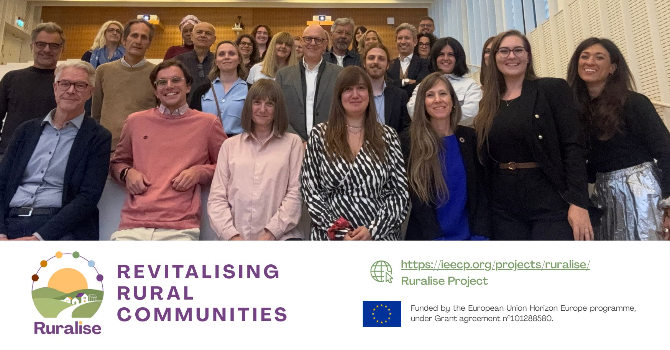
Over the past decade, European rural communities have navigated severe demographic shifts and housing pressures that have triggered a rural housing affordability crisis which pushes local youth and vulnerable residents out of their homes. To support rural areas in revitalising their communities, the EU funded Ruralise project will make housing across Europe more affordable, accessible, and climate resilient. This will be done through rigorous data collection and analysis combined with hands-on community action in Bulgaria, Finland, Greece, Ireland, Italy, and Norway, to document and address barriers within rural housing and across rural communities.
Persistent youth outmigration and lower birth rates have accelerated population decline and aging across non-metropolitan regions, leaving rural spaces vacant or deteriorating due to shrinking income or human resources to maintain communities. Concurrently, the post-pandemic rise in remote work, combined with a surge in holiday home acquisitions and short-term rentals, has inflated property prices and tightened rental supply in attractive countryside destinations. These dynamics have triggered a rural housing affordability crisis that pushes local youth and vulnerable residents out of their homes.
Despite these systemic barriers, the EU’s Long-Term Vision for Rural Areas recognises that these regions possess underutilised social, cultural, and ecological capital essential to achieving the continent’s green and digital transition goals.
The Ruralise project seeks to address this gap through rigorous data collection and analysis combined with hands-on community action in six European pilots (Bulgaria, Finland, Greece, Ireland, Italy, and Norway), supporting rural areas in revitalising their communities, and making rural housing across Europe more affordable, accessible, and climate resilient. In doing so, housing regeneration is positioned as a lever for social, economic, and environmental transformation across rural Europe.
The main output of Ruralise will be an interactive online platform, the Ruralise Studio, featuring a comprehensive knowledge centre and decision-making tool. It will bring together various data, community insights, and tested solutions to assist local governments, planners, developers, and residents in making informed choices about how to improve rural housing based on specific community characteristics and needs, making these areas more affordable, attractive, productive, and competitive.
“Improving rural housing is not just about increasing the availability or quality of residential buildings in rural areas. It is fundamentally about ensuring the future of rural communities and their capacity to remain and grow into places where people can live, work, belong, and thrive. Ruralise therefore responds to this challenge by bringing together housing and energy data, local knowledge on regenerative housing, and community-led innovation to co-create practical solutions for more affordable, inclusive, and climate-resilient rural housing that maintains and improves rural communities. In doing so, we aim to turn rural housing challenges into opportunities for regeneration, creating housing affordability and energy efficiency solutions that can be tested locally and replicated across Europe.”
Mara Oprea, Project Coordinator of Ruralise and Senior Expert at Institute For European Energy And Climate Policy (IEECP)
By combining property market and demographic trend analysis with participatory research, community-led development, and public science frameworks to co-design solutions to increase the affordability of housing alongside rural residents, Ruralise will bridge systemic market intelligence with hands-on local engagement.
The project will therefore align with the EU Renovation Wave by extending its focus specifically to vulnerable and overlooked rural districts and transforming aging buildings into energy-efficient, decarbonized, and climate-resilient ones. The project will also align the Green Deal’s Just Transition Principle by reducing energy demand, ensuring that the transition to a green economy is socially fair and leaves no community behind.

More information can be found on the project webpage: Ruralise – Revitalising Rural Communities
Funded by the European Union Horizon Europe programme, under Grant agreement n°101288580. Views and opinions expressed are however those of the authors only and do not necessarily reflect those of the European Union or REA. Neither the European Union nor the granting authority can be held responsible for them.
More from this category
 Building a new path to reclaim and renew Europe’s rural communities, the Ruralise project begins! 21.10.2026 - Over the past decade, European rural communities have navigated severe demographic shifts and housing pressures that have triggered a rural housing affordability crisis which pushes local youth and vulnerable residents out of their homes. To support rural areas in revitalising their communities, the EU funded Ruralise project will make housing across Europe more affordable, accessible, […]
 Change Begins with a Conversation: One Year of HOME EQUALS in Bulgaria 23.07.2026 - What happens when residents, local authorities, professionals and young people come together to imagine a better future for their neighbourhood? In Bulgaria, the answer is beginning to take shape. One year into the “HOME EQUALS – Improving Housing Conditions in Informal Settlements” project, communities in Kyustendil and Berkovitsa are taking steps towards better housing conditions, […]
 Bulgaria can go further to enhance long-term care for older people and secure housing for Roma communities 07.07.2026 - Strasbourg, 6 July 2026 – The Council of Europe Commissioner for Human Rights, Michael O’Flaherty, conducted a visit to Bulgaria from 29 June to 3 July 2026. The visit focused on the human rights of older persons living in long-term care facilities, as part of the Commissioner’s broader engagement on this issue across Council of Europe […]
 From informal settlements to secure homes: what Bulgaria learned from Romania 29.04.2026 - April 21–23, 2026, Bulgaria–Romania: Institutions and municipalities exchanged best practices for transforming informal settlements into sustainable and safe communities. How can unregulated neighborhoods be turned into secure and dignified places to live? And how can national and local authorities join forces to break the long-standing cycle of poverty? These questions were at the heart of […]
 Minister Nikolay Naydenov: It is imperative to immediately start working on a new National Housing Strategy 22.04.2026 - The elaboration of the new national housing strategy of Bulgaria is to be commissioned. In the assignment for this strategy, we will focus on the problems regarding social housing and neighbourhoods, defined by data and research – socio-economic, statistical, spatial, territorial-structural, sociological, financial and successful practices. This was announced by the Minister of Regional Development […]
 Guidebook on Best Practices towards the reduction of energy poverty and firewood use 22.11.2024 - Action C8 of the LIFE BioBalance project and Activity AIII.1 of the BioJust project focused on demonstrating and evidencing solutions to increase the capacity and knowledge of low-income rural communities to reduce firewood-dependency. The Action consisted of three main elements: ● Research on energy poverty and household biomass use – Fuel of the Poor study. […]